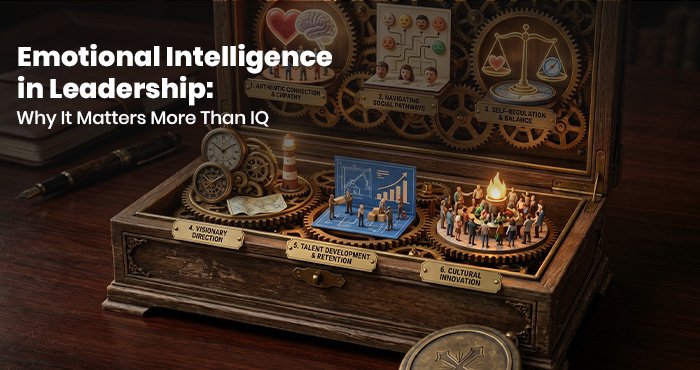
There is an ongoing revolution going on in workplaces all over the country. Organizations have realized that it is not necessarily the leader with the greatest IQ who creates the most cohesive team. It is the leader who listens, remains composed, and cares for others who creates followers without having to be asked more than once. Emotional intelligence in leadership is not a soft concept anymore. It is the deciding factor between a team that survives and a team that thrives.
Decades ago, recruitment criteria depended on academic success, grades, test scores, and technical knowledge. Intelligent individuals performed better. More qualified employees performed better. However, statistics said otherwise. Intelligent individuals quit excellent companies. Efficient teams collapsed because of bad management. It lacked something. Emotional intelligence was what was lacking, as leaders who lasted, earned people’s respect, and achieved their objectives were those who had knowledge about people, not just business matters.
The shift is real, and it is happening fast, especially across the EI in workplace USA environments where team culture and mental wellness are now front and center. If you are in any kind of leadership role today, growing your emotional intelligence is no longer optional. It is the work.
IQ Gets You the Job. Emotional Intelligence in Leadership Keeps the Team.
Being appointed to a leadership position is usually contingent on one’s qualifications — their background, their history, and what they know in terms of theory. However, once one finds themselves in such a position, none of these prepare him/her for the human aspect of being a leader. All of a sudden, he/she will be dealing with various temperaments, dispositions, needs, and drives.
This is where emotional intelligence leadership skills make the real difference. An effective leader with high emotional intelligence can gauge the atmosphere of the room and know when to push hard or hold back. Such leaders know when their team members seem to have switched off, and know to question them rather than make assumptions. These traits do not come from studying strategic leadership courses; rather, they require observation and a choice to be aware.
What Emotional Intelligence Leadership Skills Actually Look Like Day to Day
It is quite simple to discuss EQ in general terms, but what would that mean when applied in practical terms to a normal Tuesday at work? It means the manager who realizes that a normally spirited employee appears subdued decides to spend just five minutes talking to them. It also means that the team leader receives some constructive criticism from the company director and says, “Thank you; I’ll think about it.”
Emotional intelligence leadership skills also show up in how decisions are communicated. If a leader has a high level of emotional quotient, he or she will not simply shoot off an e-mail about tough changes and leave it at that. Such leaders provide room for people to ask questions; they recognize that changes are tough. They do not simply state, “This may be tough, but I’m here if you want to discuss it.”
Leadership Development Strategies That Start With Self-Awareness
Most leadership development strategies focus on productivity systems, communication tools, and goal-setting devices. These are all essential, but won’t be effective enough if the leader is not aware of their emotional responses. If the leader doesn’t know what sets them off, then no matter how many books on leadership they read, they’ll continue responding in the exact way to those stressful circumstances.
Self-awareness is where true development begins. It consists of identifying how one behaves in a state of stress, during tough times, or in situations when one’s authority comes under question. Self-awareness includes requesting honest feedback from your team members and taking it into account. When leadership development strategies include this kind of inner work, the results show up fast. Teams trust more. Communication flows more easily. Conflicts get resolved instead of being buried.
EI in Workplace USA — Why American Teams Need This Now More Than Ever
American workplaces today have evolved significantly. With remote working, the advent of a hybrid model, generational shifts, and an increased focus on mental well-being, leadership in the modern day must adapt. EI in workplace USA settings is no longer just a trend. It is an essential part of being at work.
Today’s employees do not come to work simply to get paid. They expect respect. They expect their managers to treat them as more than mere productivity machines. Organizations that are committed to creating emotionally intelligent leaders have experienced positive outcomes, including decreased turnover and increased employee engagement. Those who are not investing in emotionally intelligent leaders are losing their top talent to the door without any hassle.
How to Improve Emotional Intelligence — Practical Steps That Actually Work
What comes immediately to everyone’s mind when they find out about EQ is a pretty straightforward question: how do I even begin? And the answer to that question is also rather obvious – start with the next conversation that comes your way. Here are a couple of suggestions to make it easier for any leader to take the first step:
- Take note of your initial reaction – before you act in response to a stressful situation, breathe.
- Speak less and listen more – say “what do you think” instead of “this is what you need to do.”
- Think back on challenging conversations – ask yourself what you felt, how you reacted, and what you would do differently?
- Give your employees a chance to speak their minds.
These steps on how to improve emotional intelligence are not complicated. They are consistent. And consistency is exactly what makes them work.
Building a Workplace Success Mindset That Lasts
A workplace success mindset used to mean hitting targets, climbing fast, and staying ahead of the competition. In 2026, it means something deeper. It means building a team that wants to stay. It means creating a culture where people do their best work because they feel safe, seen, and supported. It means leading in a way that leaves people better than you found them.
Leaders who carry this mindset become more than managers — they become the kind of people their teams talk about years later with genuine respect. That kind of impact does not come from authority. It comes from emotional intelligence in leadership, practiced day after day in the small, quiet moments that nobody sees but everybody feels.
Conclusion
After years of being around a great leader, what most people tend to remember is not their decks or numbers; rather, they will remember what it was like to be face-to-face with the leader. Were they really listened to? Did they feel comfortable? Was the leader truly interested in them? This feeling is what really matters. is the work of emotional intelligence in leadership.
If you are ready to build that kind of leadership, Secrets of Emotional Intelligence by Max Jameson is the guide you have been looking for. Max Jameson’s emotional intelligence is about real, “living wisdom” — practical, authentic, and meant for leaders who are actually running their teams in the real world. Read on to begin your journey to become a powerful yet compassionate leader.
Discover what role emotional intelligence plays in workplace communications, and get real-life EQ leadership lessons.
Frequently Asked Questions
Why does emotional intelligence in leadership matter more than IQ?
IQ helps you solve problems. Emotional intelligence in leadership helps you solve people, and people are always the most difficult element of any organization. A good leader who has emotional intelligence and is capable of communicating effectively will always surpass someone who may be technically competent.
What are the key emotional intelligence leadership skills every manager needs?
The most important emotional intelligence leadership skills include self-awareness, being empathic, handling stress well, offering constructive criticism, and being able to gauge a group’s emotions. No one picks up all these skills immediately; they have to be nurtured carefully.
How does EI in workplace USA environments affect career growth?
In EI in workplace USA settings, emotionally intelligent individuals enjoy quicker promotions, greater trust in their capabilities, and a perception of being a cultural leader rather than merely an effective task manager. Organizations in the United States are currently searching for employees who possess EQ in senior positions.
What are the best leadership development strategies for building EQ?
The most effective leadership development strategies for EQ include regular self-reflection, seeking constructive feedback from your team, applying active listening skills to your everyday interactions, and studying materials such as how to cultivate emotional intelligence through everyday practices. This process takes time but always pays off.
Where do I start if I want to know how to improve emotional intelligence?
The best first step on how to improve emotional intelligence is to simply start noticing. Take notice of how you feel before having a difficult conversation. Take notice of how you respond when things do not go well. From there, start to take control of your response. Combine this with your daily practice of EQ, and you will see progress.