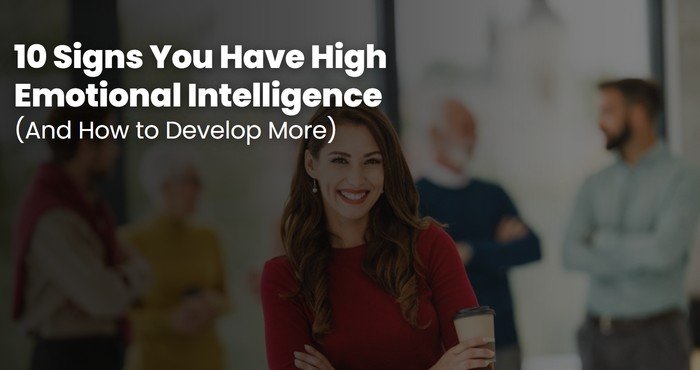
And here is another important thing that you need to think about: people who actually have high emotional intelligence do not consider themselves to be emotionally gifted. They are just too engaged in observing their own behavior patterns, being interested in others, and making better choices than wasting time on self-praise. The real signs of high emotional intelligence are not dramatic or showy. They manifest themselves in very small but steady and human-like instances, and once you know what you should be looking for, you will be surprised how easy it is to detect them.
This is not a test or some kind of contest. It is a completely honest reflection, which will help you understand where your skills are already advanced and where there is still some work to be done. Whether you can find yourself in two of these signs or in all ten of them, what counts is the path you are taking. If a couple of them seem too distant at the moment – this is also something worth noticing.
Take a close look at these ten signs, see which ones you agree with and which ones you do not and by the end you will be able to understand where you stand.
Sign 1: You Know What You Are Feeling Before It Takes Over
People with high emotional intelligence catch their emotions early before they become an issue that may harm a relationship or a conversation. Not only do they experience anger or anxiety, but they also recognize it, name it, and know, to a certain degree, why it appeared in the first place. This early recognition cannot be underestimated since it enables people to have control over their responses instead of reacting to them.
This is definitely one of the most evident signs of high emotional intelligence since most people tend to recognize their emotions only after they have already responded to them: after saying something offensive, closing the door in someone’s face, or sending a message that they will later regret sending.
Sign 2: You Can Sit With Discomfort Without Running From It
One of the most underrated high EQ traits is the ability to tolerate difficult feelings without immediately needing to fix or distract from them. Grief. Uncertainty. Disappointment. Rejection. These emotions are tough, and most people’s first reaction would be to escape from the emotion as quickly as possible. However, emotionally intelligent people have the capacity to hang around. Emotionally intelligent people have learned the art of feeling those tough emotions without allowing them to become the entire narrative.
It is not because they like feeling uncomfortable. Instead, it is because they believe that their difficult emotions will eventually pass. That capacity to sit with what is uncomfortable is one of the most honest emotional intelligence examples of what inner strength really looks like.
Sign 3: You Listen to Understand, Not to Reply
Just watch the way a person listens and you’ll find out a lot about his/her emotional intelligence. People who have high emotional intelligence listen differently. They don’t have plans of what to say when the other person finishes. They don’t half-way form judgments when the other person is halfway through. They are there for real, trying to understand what the other person really means and really feels.
Such listening is very rare, and the effect is instantly known to the recipient. If someone listens to you in such a way, you know it by the lack of interruptions, the attention he/she pays to you, and questions out of curiosity, not some other agenda. Emotionally intelligent people carry this gift into every conversation, and it quietly builds the kind of trust that most relationships spend years trying to find.
Sign 4: You Think Before You Respond in Tense Moments
Pressure reveals character. And one of the clearest signs of high emotional intelligence is the ability to pause in a tense situation, even briefly, before responding. It doesn’t mean being lazy or passive. It means being wise enough to understand that the initial response isn’t necessarily the smartest one, allowing oneself some time to make the right choice.
This quality appears in all spheres of human activity, from the way a manager reacts to negative criticism from his subordinates to the way a spouse reacts during a quarrel to the way a person reacts after having been wronged at the workplace. This pause is tiny, but the difference between reacting from it and reacting without it is huge, and emotionally intelligent people know that well.
Sign 5: You Take Responsibility Without Falling Apart
People with high emotional intelligence are not perfect they make mistakes like everyone else. What is different is what they do next. They own it. Not as an act of self-defense, nor as too much self-criticism, nor even as trying to make the other person feel guilty about calling it out. They just take responsibility for their part in what happened and commit to doing things differently next time.
This is one of the high EQ traits that leaders value most because it is a display of something that is rare and incredibly powerful. Being accountable without making a big deal out of it. Being honest without being self-destructive. The trust that is gained through this response from a leader or partner can hardly be matched by anything else.
Sign 6: You Recover From Hard Days Without Carrying Them Into Tomorrow
Resilience is a key part of high emotional intelligence not the kind that denies pain, but rather the kind that lets you acknowledge your pain and move past it without having to drag it into all the conversations after. A tough meeting, a failing project, an undesired result emotionally intelligent individuals experience all these emotions thoroughly. But then they let it sink in. They will never let one bad Tuesday make a bad month.
Here, emotional awareness becomes highly important. Once you know exactly what you are feeling and why, the chances of you blaming other people for something they have absolutely nothing to do with are much lower. Instead of being unable to control your actions without any explanation, you can just say “I had a difficult day today.”
Sign 7: You Genuinely Care About How Others Feel
Empathy is not sympathy. Sympathy feels sorry from a distance. Empathy moves closer. Emotionally intelligent people are genuinely curious about the inner lives of others, not through prying, but by being seen as attentive, caring, and a presence which makes people feel like they’re not alone. They spot when there’s something wrong before it is said. They ask the right question at the right time. They stick around even though it would be easier to leave.
This is one of the strongest emotional intelligence examples not only because of its power, but because of the effect it has on everyone who experiences it. Genuine care cannot be faked. But emotional awareness can become more natural.
Sign 8: You Set Limits Without Guilt or Aggression
The ability to set clear, honest limits without either shutting down or becoming aggressive is a high EQ trait that many people spend years trying to develop. This involves knowing your needs, realizing that they are legitimate, and having the ability to express those needs in a way that honors both you and the other person. This may not be easy, but for emotionally intelligent individuals, it is something they accomplish on a regular basis.
Self-awareness skills are at the root of this ability. But how can one set boundaries when she hasn’t acknowledged her worth yet? Or how can she embrace her right with compassion if she still hasn’t understood her own value? Learning to create healthy boundaries is an inward process first, and then it extends outwards to all your relationships.
Sign 9: You Read the Room Before You Act
Enter any room where there is an emotionally intelligent person, and they are already aware of their surroundings, aware of the vibes, the subtle tension, who needs space and who needs connection. The skill of feeling out the emotional atmosphere of a particular setting before reacting in any way is one of the most powerful and discreet signs of high emotional intelligence.
It is not about being overly sensitive and thinking too much about all your interactions. It is about being fully present and attentive to those around you – truly caring about others before reacting. This social awareness is what prevents many arguments before they even begin and this is what makes emotionally intelligent leaders so good at leading groups.
Sign 10: You Keep Growing Because You Stay Honest With Yourself
The final sign of high emotional intelligence might be the most important: the genuine commitment to continuing to grow. Emotionally intelligent people are not defensive about their blind spots. They are interested in learning about them. They are open to constructive criticism. They analyze the situations in which they acted ineptly. They remain modest enough to know that emotional intelligence is more of a process than an achievement.
This is the place where enhancing EQ abilities transforms into a process and not just an accomplishment. The most emotionally intelligent individuals you can ever come across are not those who already know everything about themselves. They are those who continue coming back, continue learning from their mistakes, and continue making better decisions in future situations.
Conclusion
If you found yourself in a few of these signs, then it is something worth noting. It proves that you have actually been working on getting to know yourself and reaching out to other people. On the other hand, if some of these signs are stretching for you a little bit, then this is absolutely fine, because this is the kind of self-awareness that allows true development.
The way forward is the same for all: just stay curious and honest, and practice. The Secrets of Emotional Intelligence by Max Jameson is the most honest and easy-to-access guide for this process. Max Jameson provides practical and real-life advice for those people who strive to develop genuine high emotional intelligence, not just act as they do. Get the book from here and build upon what you already have.
If you are interested in further developing your emotional intelligence, read about the five core EQ skills behind each sign and learn how to control your emotions with emotional intelligence methods.
FAQs
What are the most reliable signs of high emotional intelligence?
The most reliable signs of high emotional intelligence include noticing your emotions before they take over, listening with the intent to understand rather than respond, learning from mistakes and not carrying them forward, setting healthy boundaries without being aggressive, and truly caring for how others around you feel. It’s these traits that come through most clearly when under stress, which is where emotional intelligence comes into play.
What makes high EQ traits different from just being a nice person?
High EQ traits go beyond kindness or politeness. Such characteristics include self-awareness, the capability to regulate one’s emotions, understanding others’ emotions, and managing challenging situations without losing oneself and harming relationships. Politeness becomes an option when things are easy. But true emotional intelligence can be seen in challenging situations as well.
Do emotionally intelligent people ever struggle with their own emotions?
Absolutely emotionally intelligent people feel everything that everyone else feels. The difference lies in the way they respond to these emotions. They pick up on them quicker, make better sense of them, and then use their knowledge to guide their responses. The emotions are just as valid and just as strong. The only difference is the way that they approach them.
How do self-awareness skills connect to the signs on this list?
Self-awareness skills are the foundation underneath nearly every sign on this list. Identifying your emotions, knowing why you react as such, and being able to see your own patterns before it becomes a problem all of these require proper functioning of self-awareness. Without self-awareness, the majority of other characteristics associated with high EQ become very difficult to attain or sustain.
What is the most effective way to improve EQ skills if you are just starting out?
The most effective way to improve EQ skills as a beginner is to start with honest self-observation: observe how you feel during regular situations, not just emergencies. Next, make a start on one simple practice at a time: the breath that goes before the reaction, the journal entry at the close of your day, the real connection with someone you care about. Try out practices for developing emotional intelligence to begin your process.