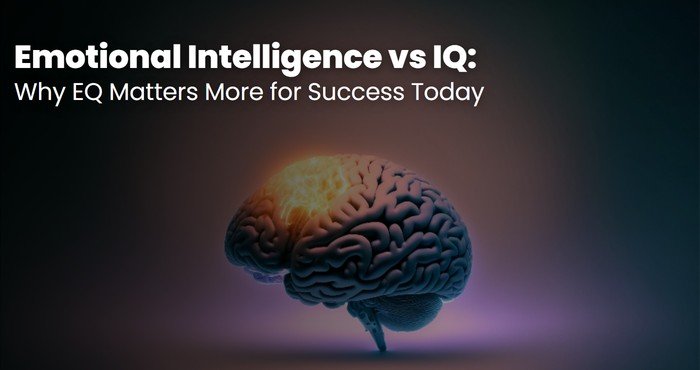
Most of us grew up believing that being smart was the ticket. Good grades, quick thinking, the right answers on the test. Then real life showed up, and something odd happened. The sharpest person in the room was not always the one people trusted, followed or wanted to work with. That gap is what the debate over emotional intelligence vs IQ is really about.
IQ is not useless. It helps you learn, reason and solve problems. But it does not tell you how you will act when a plan falls apart, when a coworker takes credit for your idea, or when someone you love is upset and cannot explain why. Those moments run on a different kind of intelligence.
In this guide, we will look at what each one measures, where they overlap, and why emotional intelligence has become such a big part of how people grow, lead and build careers today.
What IQ Measures and What It Leaves Out
An IQ test measures certain kinds of thinking: reasoning, pattern recognition, memory, verbal skill and how quickly you process information. These are real abilities, and they matter in school and in jobs that demand complex problem solving.
What an IQ score cannot tell you is how you handle frustration, whether you can read the mood of a meeting, or how you respond to criticism. Two people with similar scores can live very different lives because of what they do with their feelings. IQ shows what your mind can do. It says much less about how you use it when emotions are running high.
The Difference Between IQ and EQ in Everyday Terms
Here is a simple way to think about the difference between IQ and EQ. IQ helps you find the right answer. EQ helps you deliver that answer in a way people can hear, accept and act on.
Emotional intelligence, often called EQ, is the ability to notice, understand and manage your own emotions while also recognizing and responding well to the emotions of others. Psychologists Peter Salovey and John Mayer described the idea in academic work around 1990, and Daniel Goleman’s 1995 book Emotional Intelligence turned it into a household term. Goleman’s model groups it into five areas: self-awareness, self-regulation, motivation, empathy and social skills.
Another key difference is how much each one can change. IQ tends to stay fairly stable through adult life, while emotional skills can keep growing with practice. You cannot easily study your way to a much higher IQ, but you can become noticeably better at handling anger, listening well and staying calm.
Emotional Intelligence vs IQ at Work: Where the Gap Shows
Workplace EQ shows up in moments that never appear on a resume. A manager gives tough feedback without crushing morale. A team member notices a colleague is overwhelmed and offers help before a deadline slips. A salesperson hears the worry behind a client’s question and answers that worry instead of the surface question.
Technical skill may get you hired, but many people find their growth stalls when they cannot manage conflict, take feedback or keep a team on their side. This is where success and emotional intelligence connect. Promotions, leadership roles and client relationships often depend on whether people feel respected and understood around you. Being right is helpful. Being right in a way that brings people with you is far more powerful.
Social Intelligence: Turning Ability Into Influence
Social intelligence is closely related to EQ. It is your ability to understand social situations, pick up on unspoken rules and build relationships that work. Think of it as emotional intelligence pointed outward.
A person with strong social intelligence knows when to speak up and when to listen, how to disagree without making it personal, and how to make others feel included. These skills turn individual talent into shared results. A brilliant idea that nobody supports goes nowhere. A good idea shared by someone people trust can move a whole team forward.
The Emotional Intelligence Skills That Carry the Most Weight
Not every EQ skill matters equally in every moment, but a few show up again and again:
- Self-awareness: knowing what you feel and why, before it drives your actions.
- Self-regulation: pausing long enough to choose a response instead of reacting on autopilot.
- Empathy: understanding another person’s view, even when you disagree with it.
- Motivation: staying committed to goals that matter to you when progress is slow.
- Relationship skills: communicating clearly, handling conflict and building trust over time.
These emotional intelligence skills work together. Self-awareness without regulation leaves you knowing you are angry but saying the harsh thing anyway. Empathy without boundaries can leave you drained. Motivation without empathy can turn into pushing people too hard. Balance is the goal.
Why EQ Importance Keeps Growing Today
The world many of us live and work in has changed. More work happens in teams, across screens and with people from very different backgrounds. Messages get misread. Stress runs high. Change is constant.
In that setting, EQ importance grows because so much depends on how people handle pressure and each other. Information is easy to find. Calm, clear and caring people are harder to find, and everyone notices them when they do. That is one reason emotional skills now get discussed in workplaces, schools and families right alongside academic ones.
Final Thoughts on EQ and IQ
The real answer to the emotional intelligence vs IQ question is not that one cancels out the other. IQ gives you capacity. EQ decides how much of that capacity actually reaches the people around you. And unlike IQ, it is a skill you can keep building at any age.
If you want a clear, practical place to begin, Secrets of Emotional Intelligence by Max Jameson walks through these skills in plain language, with real-life guidance instead of dry theory. Get your copy and start building the kind of intelligence that shapes how people experience you every day.
Next in this series, we share seven practical strategies to improve your emotional intelligence, then look at the role EQ plays in strong relationships and in handling stress.
FAQs About Emotional Intelligence vs IQ
Is EQ more important than IQ?
Neither one replaces the other. IQ supports learning and problem solving, while EQ shapes how you use those abilities with people and under pressure. In roles that involve teamwork, leadership or clients, emotional skills often make the more visible difference.
Can someone have a high IQ and low emotional intelligence?
Yes. Intellectual ability and emotional skill are separate. A person can be brilliant with ideas and still struggle to manage frustration, read others or handle conflict calmly.
Can you raise your EQ as an adult?
Yes. Emotional intelligence is built through habits like noticing your feelings, pausing before reacting and listening with real curiosity. Steady practice brings steady progress, whatever your age.