

A toddler throws a toy across the room. A seven-year-old slams a bedroom door. A teenager answers every question with “fine.” Each one is a chance to build emotional intelligence for kids in the most natural way possible: at home, in real time.
Children are not born knowing what their feelings are called or what to do with them. They learn by watching the adults around them and by being guided, again and again, through big emotions. You do not need a psychology degree to do this well, just patience, a few simple habits and a willingness to stay calm when your child cannot.
This guide walks you through what emotional intelligence looks like at different ages and the everyday steps that help a child understand and manage feelings.
For adults, emotional intelligence means understanding and managing your own emotions and responding well to the emotions of others. For children, the same skills appear in smaller, simpler forms. A child with growing emotional skills can say “I’m mad” instead of hitting, notice when a friend looks sad, and wait a moment before grabbing what they want.
The Collaborative for Academic, Social, and Emotional Learning (CASEL) describes social and emotional learning as the process through which young people and adults learn to manage emotions, feel and show empathy, build supportive relationships and make caring decisions. Schools can support that process, but home is where it starts.
Kids copy what they see far more than what they hear. If a parent yells “Calm down!” while red in the face, the child learns that big feelings come out loud. If a parent says, “I’m feeling frustrated, so I’m going to take three slow breaths before I answer,” the child learns that feelings can be named and handled.
This does not mean hiding your emotions. Seeing a parent feel disappointed or annoyed and then cope in a healthy way shows children that emotions are normal and manageable.
When you lose your temper, which every parent does, go back and repair. “I shouted earlier and that wasn’t okay. I’m sorry” teaches more than any lecture.
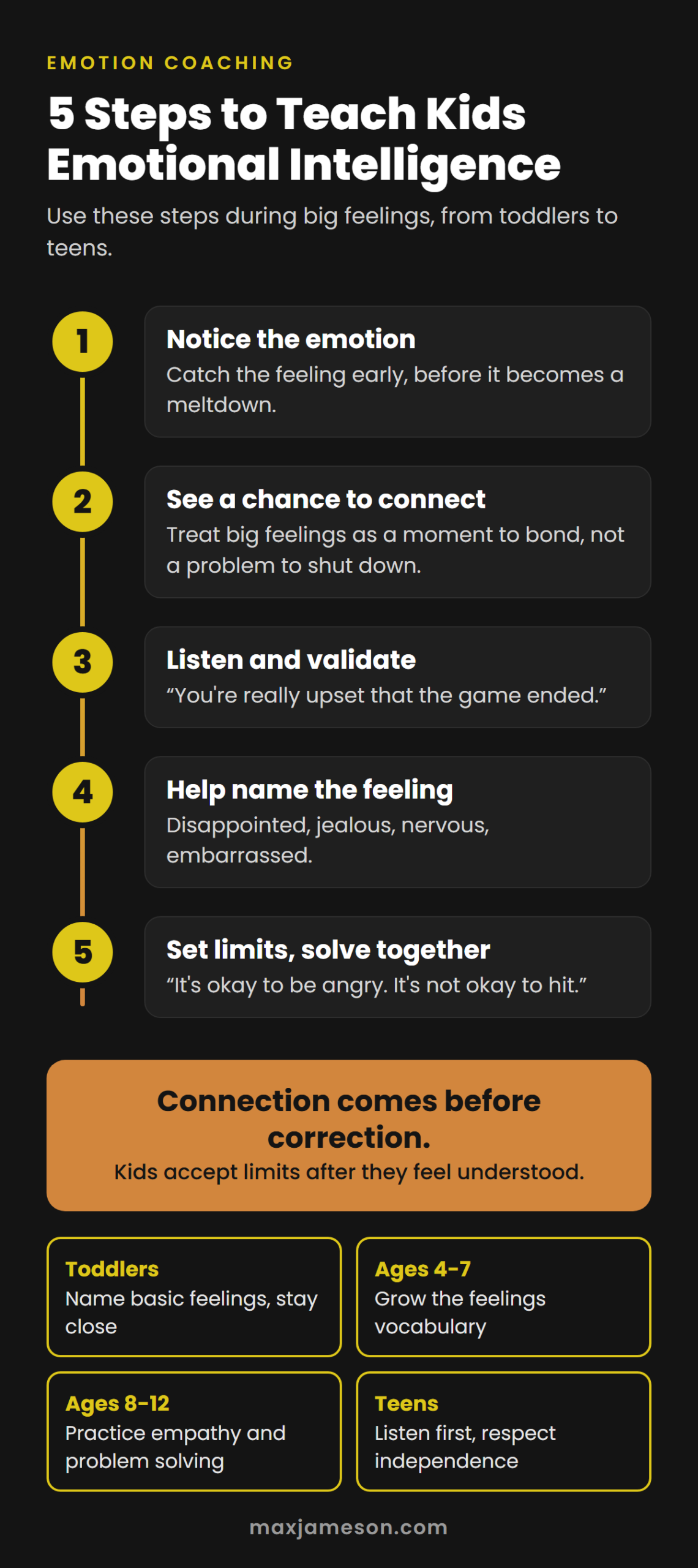
Psychologist John Gottman studied how parents respond to their children’s emotions and described an approach he called emotion coaching in his book Raising an Emotionally Intelligent Child. The Gottman Institute presents it as a five-step method parents can use from toddlerhood through the teenage years. In simple terms, the steps are:
The order matters. Children rarely accept a limit or a solution until they feel understood first. Connection comes before correction.
A child who only knows “happy,” “sad” and “mad” has very few tools for describing what is going on inside. Expanding that vocabulary is one of the simplest ways to teach kids emotions.
Try these easy habits:
When children can name a feeling, they gain a little distance from it. “I’m nervous about the test” is easier to work with than a stomachache and a refusal to go to school.
A child in the middle of a tantrum cannot learn a new skill. Practice calming tools when everyone is relaxed, so they are familiar when emotions run high.
Good options include slow “balloon” breathing, counting to ten, squeezing a pillow or a few minutes in a cozy calm-down corner. Offer these as choices, not punishments. The goal is for your child to learn, “When I feel this way, I can do something that helps.”
| Age | What to focus on | Try saying
|
|---|---|---|
| Toddlers (1-3) | Naming basic feelings and staying close during meltdowns | “You’re sad. I’m right here.” |
| Young children (4-7) | Bigger feelings vocabulary and simple calming tools | “Is it more mad or more disappointed?” |
| Older children (8-12) | Empathy, perspective taking and problem solving | “How do you think your friend saw it?” |
| Teenagers | Listening without fixing and respecting independence | “Do you want advice, or just someone to listen?” |
None of this works after one conversation. Kids need hundreds of small, repeated moments of guidance before a skill becomes their own. Some days your child will name a feeling and take a breath like a pro, and the next day melt down over the wrong color cup. That is normal development, not failure.
Celebrate effort over perfection. “I saw you take a deep breath when your brother grabbed your toy. That was hard, and you did it” tells your child exactly what to do again.
Think back to your own childhood for a moment: what is one thing you wish an adult had said to you when you were upset? That sentence might be exactly what your child needs to hear from you this week.
Teaching emotional intelligence to children is also a chance to grow your own. Every time you stay calm, name a feeling and repair after a rough moment, you strengthen the same skills you hope to pass on.
If you want a clear guide for your own emotional growth, Secrets of Emotional Intelligence by Max Jameson covers how to build self-awareness, strengthen empathy and identify emotional triggers. It is written for readers from teens to adults, so it can be a book the whole family learns from.
In the next post, we look at the difference between emotional intelligence and emotional maturity, and why you need both.
You can start in infancy by naming feelings and responding warmly to your baby’s cues. Toddlers can begin learning simple feeling words, and older children can work on empathy and problem solving.
Don’t force it. Talk side by side during a car ride or walk, and share your own feelings first.
No. You can accept the feeling and still hold the limit. “You’re angry that screen time is over, and it’s still time for bed” does both.
If your child’s emotions often feel extreme, last a long time or get in the way of school, friendships or sleep, talk to your pediatrician or a licensed child therapist.