

A friend tells you their marriage is falling apart. You want to help, so you say, “Oh no, I’m so sorry. At least you don’t have kids together.” You meant well. But your friend goes quiet, and the conversation never quite recovers.
What went wrong is one of the most common mix-ups in everyday relationships: the difference between empathy vs sympathy. Both come from caring. Both are kind impulses. But they land very differently on the person who is hurting.
Understanding that difference is one of the most practical ways to grow your emotional intelligence, because it changes how people feel after they talk to you.
Sympathy is feeling sorry for another person’s pain or misfortune. It sounds like “That’s terrible” or “I’m so sorry that happened to you.” Sympathy is not a bad thing. Condolence cards, flowers and kind messages are all forms of sympathy, and they can be comforting.
The limit of sympathy is distance. It looks at someone’s struggle from the outside. Sometimes it slips into pity, which can leave a person feeling smaller rather than supported.
Empathy goes a step further. Instead of feeling sorry for someone, you try to understand what it is like to be them in that moment.
The Greater Good Science Center at UC Berkeley explains that researchers generally define empathy as the ability to sense other people’s emotions together with the ability to imagine what someone else might be thinking or feeling. They describe two types: affective empathy, which is feeling something in response to another person’s emotions, and cognitive empathy, which is identifying and understanding those emotions, sometimes called perspective taking.
In practice, empathy sounds less like “You poor thing” and more like “That sounds really lonely. I’m here.”
| Sympathy | Empathy
|
|
|---|---|---|
| Position | Looking at the pain from outside | Trying to understand the pain from inside |
| Typical words | “I’m so sorry for you.” | “That sounds really hard. Tell me more.” |
| Focus | Your reaction to their situation | Their experience of the situation |
| How it can feel | Kind, but sometimes distant | Understood and less alone |
Researcher and author Brené Brown made this distinction famous in a short animated talk called RSA Short: Empathy. Her message is that empathy builds connection, while sympathy can drive it away, especially when we rush to make the pain smaller with phrases that start with “at least.”
When people share something painful, they rarely want a quick fix or a silver lining. They want to feel that someone understands. Empathy gives them that. It tells the other person, “You are not alone in this,” which is often what helps most.
Compassion is closely related, and it is worth knowing where it fits. Empathy is understanding and sharing in someone’s feelings. Compassion adds the wish to help and, often, an action to ease their suffering.
The Greater Good Science Center notes that empathy does not necessarily mean we will want to help someone, though it is often a vital first step toward compassionate action. Think of it as a path: you understand first, and then you act with care.
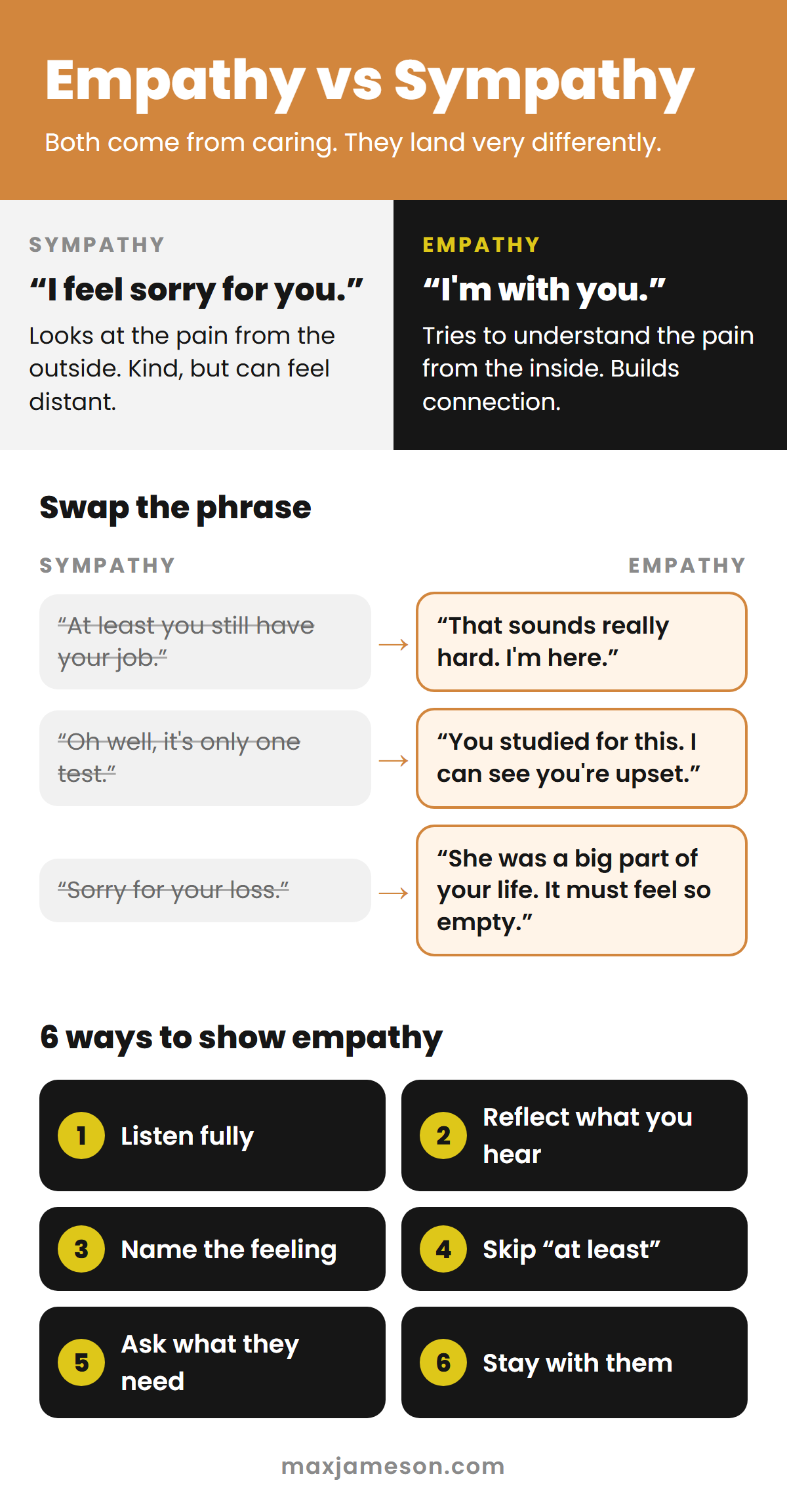
Empathy is a skill, and like any skill, it improves with practice. These steps make it easier to offer in the moment:
Empathetic listening is less about having answers and more about being present.
Here is how the same situation can sound with sympathy and with empathy:
Notice that the empathetic replies do not try to fix anything. They show understanding first.
Now think about your own life for a second: when was the last time someone truly understood what you were going through, and what did they say that made the difference?
Empathy does not mean taking on every feeling around you until you are drained. Supporting someone is easier when you also look after your own emotional health. It is okay to care deeply and still step back to rest, set limits on your time or encourage someone to seek professional help when their struggle is bigger than a friend can carry.
Sympathy says, “I feel sorry for you.” Empathy says, “I’m with you.” Both come from a good place, but empathy is what helps people feel understood. With practice, it becomes your natural response.
To keep building this skill, Secrets of Emotional Intelligence by Max Jameson shares seven strategies to boost empathy and strengthen every relationship. It is a practical guide for anyone who wants their care to truly reach the people they love.
This series has also covered how to stop taking things personally and the difference between emotional intelligence and emotional maturity.
Sympathy is feeling sorry for someone’s pain from the outside. Empathy is trying to understand and share what they are feeling from their point of view.
No. Sympathy is kind and often appropriate, such as in condolence messages. It simply creates less connection than empathy in close, personal conversations.
Yes. The Greater Good Science Center points to research suggesting people can enhance their natural empathic abilities. Everyday practice, such as active listening and imagining another person’s perspective, is a good place to start.
Empathy is one of the core skills of emotional intelligence. It helps you understand others’ emotions, which improves communication, trust and relationships.
Avoid phrases that minimize the pain, such as “at least” statements, quick advice they did not ask for or turning the conversation toward your own story.