

A friend doesn’t reply to your message. Your manager gives short, flat feedback. Someone across the table sighs while you are speaking. Within seconds, your mind fills in the story: they’re annoyed with me, I did something wrong, I’m not good enough.
If that pattern sounds familiar, you are far from alone. Learning how to stop taking things personally is one of the most freeing emotional skills you can build. It does not mean becoming cold or pretending nothing bothers you. It means separating what actually happened from the story your mind adds on top of it.
Emotional intelligence gives you the tools to do exactly that.
Taking things personally usually starts with a fast, automatic interpretation. Our brains are built to look for meaning, especially in social situations, and they often place us at the center of the picture.
Psychologists have a name for part of this habit. In a 2000 study, Cornell psychologist Thomas Gilovich and his colleagues asked students to walk into a room wearing an embarrassing T-shirt. The students expected far more people to notice the shirt than actually did. The researchers called it the spotlight effect: we overestimate how much other people notice and think about us.
The same thing happens with moods and comments. Most of the time, people are thinking about their own worries, deadlines and feelings, not judging us.
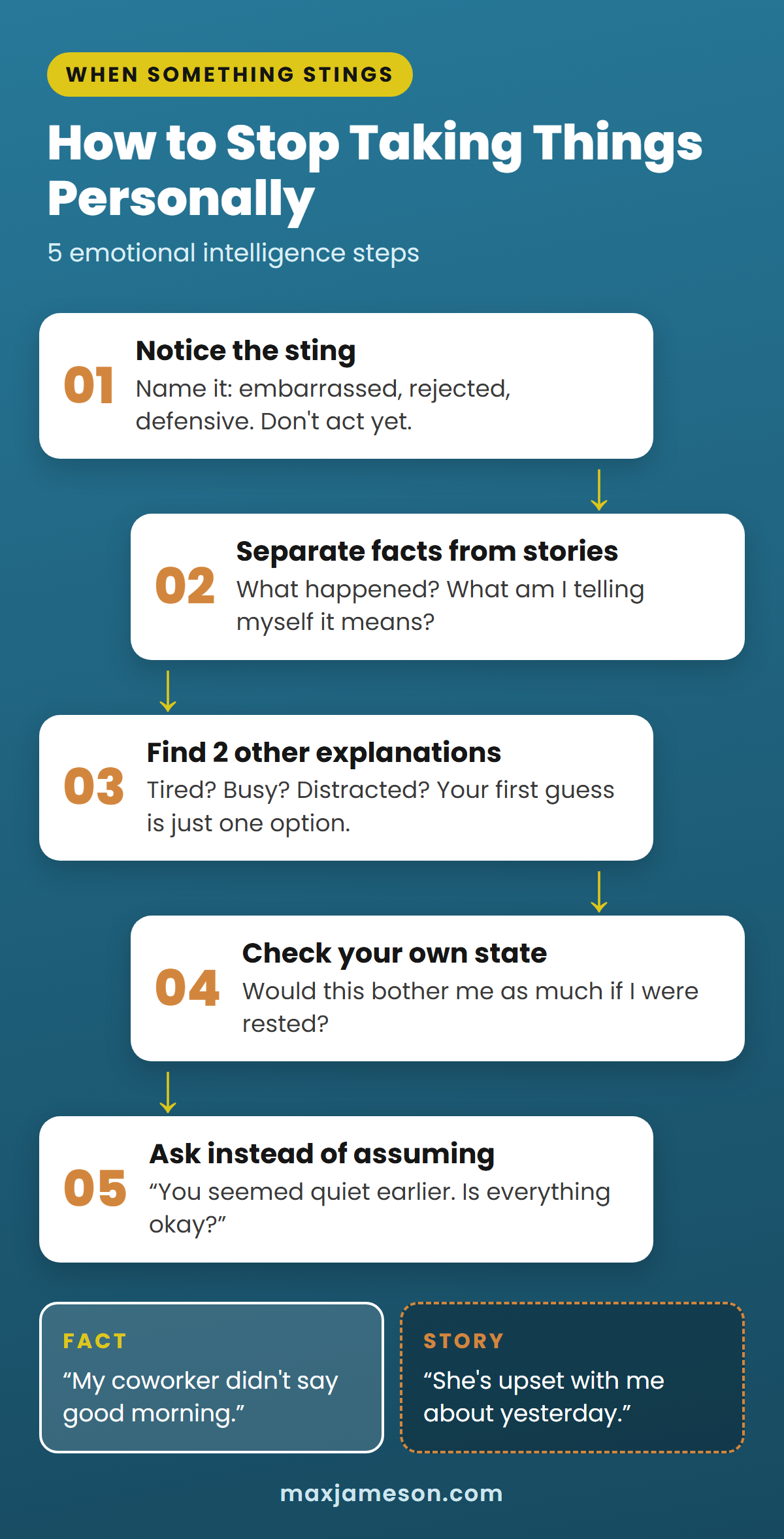
Emotional self-awareness is the starting point. When a comment or silence hurts, pause and name what you feel: embarrassed, rejected, defensive, anxious. Naming the feeling gives you a small amount of space between the trigger and your reaction.
In that space, you can choose not to fire back a reply, withdraw or replay the moment for the rest of the day. You do not have to make the feeling go away. You just have to keep it from driving.
Ask yourself two questions: What actually happened? And what am I telling myself it means?
The fact might be “My coworker didn’t say good morning.” The story might be “She’s upset with me about yesterday’s meeting.” Only the first part is certain. Writing both parts down makes it easier to see where you have filled in the blanks.
Once you spot the story, come up with at least two other possible reasons for what happened. The coworker might be tired, distracted by a family problem or rushing to a call. The short email might simply reflect a busy afternoon.
This is reframing thoughts in a practical way. You are not forcing yourself to believe the kindest explanation. You are reminding yourself that your first explanation is only one of several, and often not the most likely.
We take things more personally when we are already tired, hungry, stressed or feeling insecure. Emotional sensitivity rises when our reserves run low. A comment you would shrug off on a good day can feel like a personal attack after a bad night’s sleep.
Before reacting, ask, “Would this bother me as much if I were well rested and in a good mood?” If the answer is no, the problem may be your current state more than the comment itself.
When something matters, the clearest way to stop guessing is to check. Keep it simple and curious, not accusing:
Usually the answer is far less personal than you feared. If there is a real issue, you can now talk about it directly.
Work is one of the hardest places to keep perspective, because your performance, income and reputation feel tied to every comment. A few habits help:
Sometimes a comment is meant to hurt. Emotional intelligence does not ask you to pretend otherwise. It asks you to respond from a steady place rather than a wounded one.
Consider whether there is any useful truth in what was said. Take what helps and leave the rest. If someone is regularly unkind or disrespectful, that is information about the relationship and may call for clear boundaries, not more self-blame.
At its root, taking things personally often comes from feeling that your value is always up for review. When your self-worth depends on every reaction from other people, each sigh and short reply feels like a vote against you.
A steadier sense of self-worth comes from knowing your values, keeping your own commitments and treating yourself with the same fairness you would offer a friend. Each time you choose curiosity over assumption, you strengthen it.
So here is a question for you: what is one comment or situation from this past week that you took personally, and what is another way you could read it now?
You will not stop feeling hurt from time to time, and that is not the goal. The goal is to notice the sting, check the facts, consider other explanations and respond in a way you feel good about later.
If you want to go deeper, Secrets of Emotional Intelligence by Max Jameson explains how to identify emotional triggers using mindfulness techniques and how to build self-awareness without judgment, two skills at the heart of taking things less personally.
This series has also covered emotional intelligence vs emotional maturity. Next, we look at empathy vs sympathy and why the difference matters.
Common reasons include low self-worth, past experiences of criticism, stress and tiredness, and the natural tendency to see ourselves at the center of events. Noticing your own pattern is the first step to changing it.
Not necessarily. Many sensitive, caring people take things personally. Emotional intelligence helps you notice the reaction and choose a calmer, more accurate response.
Focus on what the feedback says about the task, ask for specific examples and give yourself time before replying. Treat it as direction for the work rather than a judgment of you.
Yes. If this pattern causes ongoing distress or strains your relationships, a licensed therapist can help you explore where it comes from and practice new ways of responding.